


.png)
What is Angioplasty? Explained Simply.

Updated: Apr 16
Many patients come to me confused: “Doctor, I have blockage. Do I really need angioplasty?”
Before answering that, you must first understand what angioplasty actually is.
What Does Angioplasty Mean?
Let’s simplify the word.
• Angio = blood vessels
• Plasty = repair
So angioplasty means repairing a blocked blood vessel.
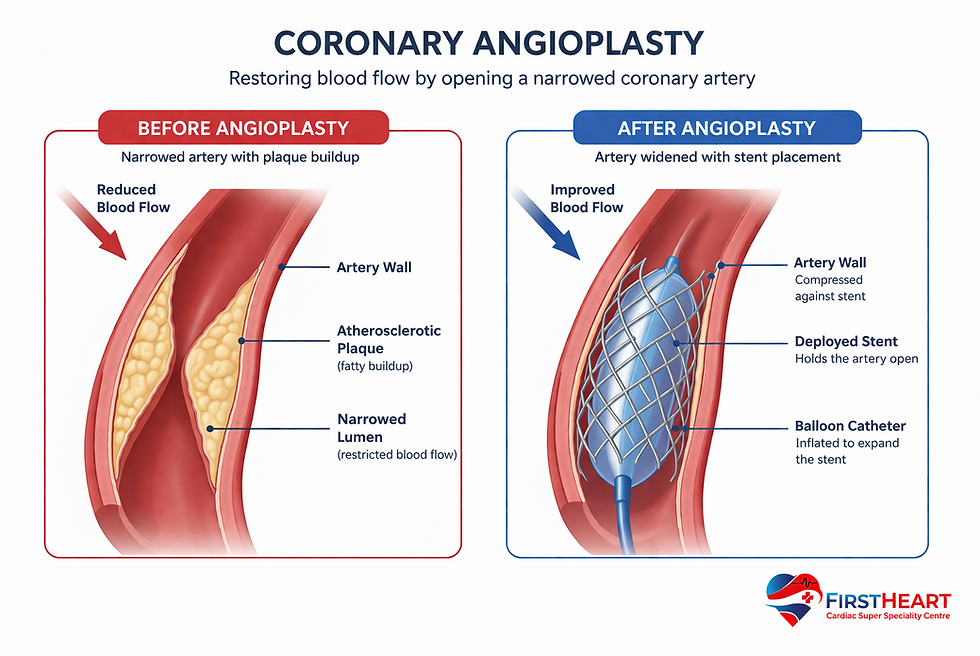
If done for heart blockage, it is called coronary angioplasty or PCI (Percutaneous Coronary Intervention).
When Do You Need Angioplasty?
This is not a simple yes or no decision. Many factors matter.
1. Which artery is blocked?
• small artery → may not need angioplasty
• major artery → more likely needed
2. How severe is the blockage?
• mild (30–50%) → usually medicines
• severe (80–100%) → may need intervention
3. How many arteries are involved?
• 1–2 arteries → angioplasty often preferred
• multiple arteries → sometimes bypass surgery
4. Your overall health
• diabetes
• kidney disease
• infection
All these affect the decision. The best person to decide about angioplasty is the treating cardiologist.
Important Point :
Not every blockage needs angioplasty. And not every patient with blockage should be treated the same way. This decision is always patient-specific.
And if you are not sure whether you need angiography or angioplasty, you can all us on 7208774409 & take appointment with our cardiologist for a second opinion.
What Happens During Angioplasty? Let’s make it simple.
• a thin wire is passed into the artery across the blockage
• a balloon reaches the blockage over the wire and is inflated to open the blockage
• a stent is placed at the opened site to keep it open
The stent acts like a support so the artery does not collapse again.

Special Situations During Angioplasty.
Sometimes things are more complex.
If there is clot: it can be removed by a special procedure called thrombus aspiration
If blockage is very hard (calcium): special techniques like rotablation, orbital atherectomy, lithotripsy are used
Some bloackages may need laser-based therapy (ELCA)
Key Takeaways
• angioplasty opens blocked heart arteries
• not every blockage needs it
• decision depends on multiple factors
• medicines, angioplasty, or bypass all have roles
• trust a personalised medical decision from qualified cardiologist
Frequently Asked Questions
Is angioplasty always required for blockage?
No. Many patients can be treated with medicines.
Is angioplasty better than bypass?
Depends on your condition.
Is angioplasty a major open heart surgery?
No. It is a minimally invasive procedure.
How do I decide what is right for me?
Based on your reports and cardiologist’s advice.
Will You Be Conscious During the Procedure?
Yes. Only local anesthesia is given
How Long Does It Take?
Usually 1–2 hours. It can be longer in complex cases
How safe it is?
With recent advances, it has become a very safe procedure.
Watch the Full Explanation here
If you have been advised angiography or angioplasty and you are looking for a second opinion, you can contact us on 07208774409 and take appointment with our cardiologist Dr C B Munjewar for physical or video consultation.


Comments